On the heavy, heartbreak drive to end my daughter’s pregnancy, we pulled into a remote gas station where a broken, three-legged dog was waiting to show us a version of the future we were too scared to imagine.
The Sanctuary on Three Legs
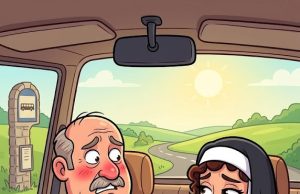
The atmosphere within the sedan was heavy, a thick and suffocating veil of unresolved resentment that seemed to vibrate with every revolution of the tires against the interstate. We were still three hours away from the facility in the city, and to me, each white mile marker flashing past the window felt like the rhythmic ticking of a countdown I was powerless to stop. My mind was a chaotic loop of the previous night’s confrontation, specifically the way the veins in Silas’s neck had bulged as he stood in our kitchen, his face a terrifying shade of crimson while he leveled a trembling finger at my chest.
“We are absolutely not bringing another life into this house to raise,” he had bellowed, the sound of his voice shattering the fragile peace of our home. “If she doesn’t handle this situation immediately, she can pack her things and find a different roof to sleep under, because I am finished.”
The boy responsible for the upheaval had vanished into the shadows of the next state over, spirited away by parents who viewed a scandal as a fate far worse than an abandoned responsibility. Consequently, there I was, gripping the steering wheel with such intensity that my knuckles had turned a ghostly, bloodless white, playing the part of the facilitator because I believed it was the only way to ensure my daughter still had a place to call home. Chloe hadn’t uttered a single syllable in seventy-two hours; she simply sat in the passenger seat, her gaze fixed on the blurring landscape of rural Ohio, looking remarkably small and utterly hollowed out by fear.
The Encounter at the Dust-Caked Pump
By the time we reached the halfway point, the physical ache in my chest had become a persistent, gnawing pressure that demanded a reprieve. I spotted a faded, sun-bleached sign for a roadside service station and pulled the car over, the tires crunching loudly on the parched gravel. I told Chloe I needed to stretch my legs and procure some caffeine, leaving her perched on a weathered wooden bench near the side of the building while I retreated into the air-conditioned sanctuary of the convenience store. I bought two cups of coffee I didn’t actually want and stood by the glass doors for several minutes, watching my breath fog the pane as I tried to summon the strength for the final leg of the journey.
When I finally pushed the doors open and stepped back into the blinding heat of the afternoon, I came to a dead halt, the cardboard carriers sagging in my hands. Sitting on that splintered bench, pressed firmly against Chloe’s side, was a massive Golden Retriever whose appearance was as rugged as the landscape around us. He was a survivor of a different sort, completely missing his front left limb, with a coat that was patchy and dull from a lack of proper care. Chloe, who had remained a statue of dry-eyed stoicism even while her father screamed his ultimatums, was now sobbing with a raw, primal intensity that shook her entire frame.
She had her arms draped around the dog’s thick, muscular neck, burying her face in his coarse fur while he sat with a staggering, tilting stillness. He wasn’t panting or trying to solicit play; he simply rested his heavy chin on her knees and used his tongue to gently catch the tears as they tumbled down her cheeks. As I drew closer, my heart hammering a frantic rhythm against my ribs, I heard her whispering to the animal in a voice that was fractured and thin.
“I’m so sorry,” she choked out, her fingers digging into his golden coat. “I’m failing everyone because I can’t protect what’s mine, just like the people who threw you away didn’t protect you.”
The Sixth Sense of the Discarded
I stood frozen in the heat until a woman wearing a grease-stained denim jacket and heavy work boots hurried over from a nearby flatbed truck. She appeared to be in her late fifties, her face a map of deep-set lines that only served to emphasize the startling kindness in her eyes. She offered an immediate apology, explaining that the dog had managed to slip his lead while she was reorganizing the cargo in the back of her truck. I managed a weak nod, whispering that no harm had been done, while the woman watched my daughter cling to her animal.
“Don’t mind him too much; Barnaby has always had a sixth sense for a heart that’s about to break,” she said softly, her voice carrying the warm, grounding weight of someone who had seen it all. “We found him dumped right here at this very pump over a year ago. Someone had hit him with their car, and rather than settling the vet bill for his leg, they just unhooked his leash and drove away into the night.”
“They saw him as a burden,” she added, the word landing in the dusty air with the force of a physical strike.
The term echoed in my mind, a perfect, ugly mirror of the way Silas viewed the child Chloe was carrying—an inconvenience, a financial drain, a clerical error that needed to be deleted from the record. The woman introduced herself as Martha, and she gestured toward the truck where her husband, Ben, was leaning against the tailgate. Sensing the gravity of the moment, Martha invited us to join them for a moment, offering hot cocoa from a weathered thermos. Under any other set of circumstances, I would have declined the intrusion of strangers, but Chloe refused to break contact with Barnaby, and the dog was glued to her hip as we moved toward the shade of a large oak tree.
The Alchemy of a Broken House
As we sat on the lowered tailgate, sipping the lukewarm liquid, Martha and Ben shared the architecture of their own lives. They spoke of two decades spent in the grueling pursuit of a family that never materialized—years of failed treatments, the quiet agony of empty nurseries, and the slow erosion of a dream they eventually had to let go of. They had taken their life savings and bought a dilapidated farm on the edge of the county, transforming it into a sanctuary for the animals the rest of the world considered obsolete: the blind, the elderly, and the three-legged survivors like Barnaby.
“People look at these creatures and see something that’s been used up or broken beyond repair,” Martha said, looking directly into Chloe’s swollen eyes. “But they aren’t broken. They’ve just been weathered by a world that doesn’t know how to value things that require a little extra patience.”
Ben leaned forward, his rough, calloused hands clasped between his knees. He explained that they had spent ten years on every adoption list in the Midwest, only to be told time and again that their age made them less than ideal candidates for a child. “We’re just two souls with a surplus of love and a farmhouse that’s far too quiet for its own good,” he said, his tone devoid of any pitch or pressure. It was just an honest admission whispered to a pair of strangers at a highway stop.
Chloe looked down at Barnaby, who had fallen into a deep sleep across her sneakers, his tail giving a single, rhythmic thump against the pavement. When she finally looked up at me, the hollow vacancy in her eyes had been replaced by a tiny, flickering spark of something I hadn’t seen in months. She reached out and gripped my hand, her fingers trembling with a sudden, desperate resolve.
“Mom,” she whispered, the word barely audible over the hum of the passing trucks. “Do we really have to finish this journey? Can we just go home?”
I thought of Silas and the storm that would undoubtedly erupt the moment we crossed the threshold without the paperwork he demanded. I knew that my marriage, already strained to the snapping point, would likely disintegrate into a pile of ash before the sun went down. But as I looked at my daughter, I realized that my primary vocation wasn’t the preservation of a comfortable husband, but the protection of my child. I set my cup down on the metal tailgate and took a deep breath. “We’re going home, Chloe. Right now.”
The Anatomy of a New Foundation
The return trip was a complete inversion of the first half of the day. The suffocating silence was replaced by a torrent of words as Chloe talked until her voice went hoarse, detailing her fears and the physical sensation of a weight being lifted from her shoulders. When we finally pulled into our driveway, I walked through the front door and presented Silas with the truth. He reacted precisely as I anticipated—a glass was shattered against the wall, a suitcase was packed in a fit of rage, and he vanished to his brother’s house, screaming that I had sabotaged our future for a mistake. I locked the door behind him, and for the first time in years, I felt a profound, unshakable sense of peace.
Over the following six months, Martha and Ben became the foundation upon which we rebuilt our lives. They didn’t intrude, but they were consistently, quietly present in the gaps where Silas had once stood. When the physical strain of the pregnancy became too much for Chloe, Ben appeared on our porch with a custom-built ergonomic chair he had fashioned in his workshop. When the social fallout at the high school became a vicious tide of whispers, Martha would arrive to take Chloe for long drives, letting her vent her frustrations into the wind.
And Barnaby was a permanent fixture of every visit. The three-legged dog would immediately navigate his way to Chloe, resting his massive head precisely on her lap and falling asleep as if he were monitoring the baby’s heartbeat through the fabric of her dress.
The Legacy of the Gold
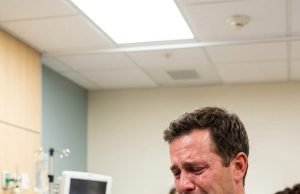
In the early hours of a rain-lashed spring morning, the call came. We reached the local hospital in a blur of wipers and adrenaline, finding Martha and Ben already waiting in the lobby, their faces etched with a familiar, anxious hope. When my grandson finally entered the world—a healthy, screaming force of nature—the nurses eventually settled him into Chloe’s arms. She held him against her skin for an eternity, tracing the map of his tiny fingers and whispering promises of a life built on something stronger than convenience.
Then, with tears streaming freely down her face, she looked toward the woman who had helped her find the courage to stay. “Martha, would you like to hold him?” she asked. The weathered, resilient woman who had spent her life mending broken dogs dropped to her knees on the linoleum and wept as she took the child into her arms.
Two years later, we gathered in the expansive backyard of the farm to celebrate the boy’s second birthday. The Kentucky bluegrass was a vibrant, emerald carpet under the summer sun, and a small, energetic boy was sprinting across the lawn, chasing a tattered red ball with reckless abandon. Keeping pace with him, herding him gently away from the rosebushes with a fiercely watchful eye, was Barnaby. The dog moved with a rhythmic, hopping gait on his three legs, never missing a step and never allowing the boy to wander too far from the center of the pack.
Chloe stood beside me on the porch, watching her son run toward Martha and Ben, calling out to them with a joy that filled the entire valley. She leaned her head against my shoulder and watched the three-legged guardian navigate the grass. “You know, Mom,” she whispered, a radiant smile finally claiming her face. “That gas station was the luckiest break we ever had. We definitely made the right choice.”
I looked at the house Silas had left—the one I had sold to move closer to this farm—and then at the family we had forged from the ruins, and I knew she was right. Some things aren’t broken; they’re just waiting for the right hands to hold them.