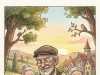
My husband had promised me a big surprise for our 55th Christmas together—yet he passed away two months before. On Christmas morning, while I was at church, a stranger approached me and handed me a diary. The first page read: “Did you think I wouldn’t keep my promise? Follow the instructions on the next pages… and do not tell our children.”
I met Robert Hale when I was twenty-two, and for fifty-five Christmases we built a life that was quiet, steady, and full of love. He wasn’t the type for grand gestures or dramatic promises.
So when, two months before what would have been our fifty-fifth Christmas, he squeezed my hand in his hospital bed and said, “I still owe you a big surprise this year,” I laughed it away. He was ill, and in that moment, surprises felt insignificant compared to the unspoken fear between us. He passed in October.
By December, I was drifting through my days, a visitor in a life that no longer felt like mine. Christmas arrived anyway. I went to church alone, sat in our usual spot, and tried to sing without my voice giving out.
After the service, as people offered quiet condolences, a stranger approached me near the steps—a tall man in his forties, wrapped in a simple gray coat.
“Margaret Hale?” he asked.
When I nodded, he placed a small leather-bound journal in my hands. “He wanted you to have this today. He said you’d know why.”
Before I could ask a single question, the man turned and disappeared into the parking lot.
I opened the journal immediately. On the first page, in Robert’s unmistakable handwriting, were the words:
Did you think I wouldn’t keep my promise? Follow the instructions on the next pages… and do not tell our children.
My heart raced. Robert had never kept secrets from Emma and Daniel, our grown children with families of their own. The next page was brief and direct: Go home. Open the hall closet. Take the blue envelope. Read it alone.
Back home, my hands trembled as I found the envelope tucked behind heavy winter coats. Inside was a key and a note with a single instruction: Drive to 417 Maple Street. Noon.
Maple Street sat across town, near the neighborhood where we’d once rented our first apartment. When I arrived, a modest brick house stood freshly painted. A realtor waited on the porch, checking her watch. When she saw me, she smiled gently.
“You must be Margaret.”
Still dazed, I followed her inside. Every wall was lined with framed photographs from my life with Robert—our wedding day, our first Christmas, our children as babies.
In the center of the living room was a neatly wrapped box, large and square, with a note resting on top in Robert’s handwriting.
That was when my knees nearly buckled, and I understood this surprise was far more intentional—and far greater—than I had ever imagined.
The realtor helped me sit, then quietly stepped outside, as though she knew this moment was meant to be private. I unwrapped the box slowly. Inside was a polished wooden chest, the kind Robert always admired in antique shops but never bought. Resting on top was another page from the journal.
This house isn’t a gift to own, it read. It’s a place to remember.
Inside the chest were neatly labeled folders, organized by year. Letters, photographs, receipts, handwritten notes. Robert had preserved our entire life together—not for sentiment, but for meaning. The next instruction was simple: Read the folder marked “1989.”
That was the year we nearly separated. I remembered the arguments, the silence, the fear that we might fail. Inside was a letter Robert had written but never given me, admitting his mistakes, his pride, and his decision to stay and fight for us. My hands shook as I read words I had waited decades to hear.
The journal led me through year after year—through joy, regret, resilience. Each folder ended with a reflection from Robert: what he learned, what he wished he’d done differently, what he remained grateful for.
By late afternoon, I reached the final instruction: Call Emma and Daniel. Tell them you’re ready.
I hesitated. Keeping the secret had weighed heavily all day. But I called. When they arrived—confused, concerned—I handed them the journal. Robert had written separate letters to each of them, explaining everything.
The house, I learned, was not meant for us alone. Robert had quietly funded it as a community space—a place where couples could share real stories of marriage, including the struggles and the choosing. He’d worked with counselors and local historians to create a home for memories, so younger families could understand that love is not effortless—but it is worth choosing, again and again.
“I couldn’t stay,” his final letter said, “but I could leave something honest behind.”
That evening, we sat together on the living room floor, surrounded by the evidence of a lifetime. We cried, we laughed, and at last we understood the depth of the promise he had kept.
Robert hadn’t left me a possession.
He had given purpose to the life we shared—and opened it so others could learn from it.
The house on Maple Street opened quietly the following spring. There were no ceremonies, no press, no grand announcements. Only a simple sign by the door: Real Stories. Real Marriages. Couples arrived cautiously at first, then with visible relief. They read letters from strangers they would never meet, yet somehow found their own lives reflected in every word.
I began volunteering there twice a week. Some days I guided visitors through the rooms. Other days, I simply sat and listened. The moments that stayed with me weren’t dramatic—they were tender and ordinary: a young husband brushing away tears, a wife tightening her grip on her partner’s hand after reading about forgiveness from someone who had lived it.
Emma and Daniel eventually told their children about their grandfather’s work. Watching my grandchildren wander through those rooms, asking thoughtful questions about love and commitment, felt like Christmas morning all over again.
One quiet evening, I finished the diary alone. The final page held no instruction—only a question Robert had written for me, meant not to be answered aloud, but carried forward in life: What will you do with the love we built?
I chose to keep telling our story—not as something flawless, but as something honest. Because in a world where love is often treated as easy or disposable, Robert left behind proof that it is effort worth making.
If this story touched you or brought someone you love to mind, consider sharing it. Tell your own story. Leave behind something true for those who come after you. And if you believe that real love still matters today, let that belief show—in your words, your actions, and the promises you choose to keep.