The Silent Sentinel of the Nursery
The sound of the wooden crib hitting the floorboards was not merely a noise; it was a violent percussion that seemed to vibrate through the very foundations of our home. I spun around, my heart hammering a frantic rhythm against my ribs, as a cold wave of adrenaline washed over me. My hands instinctively flew to my midsection, cradling the seven-month-old life growing within me, as I stared at the wreckage in the corner of the freshly painted nursery. There stood Silas, a massive, blocky-headed pit bull mix, his muscular frame racking with violent, uncontrollable tremors.
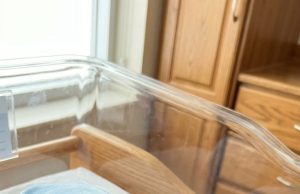
My husband, Elias, had brought Silas home a year ago, and from the moment he crossed our threshold, the dog had been a source of constant, simmering tension. He was a roadmap of human cruelty, missing the upper half of his left ear and covered in a network of jagged, silvered scars that stood out starkly against his brindled coat. He suffered from a brand of separation anxiety so profound it bordered on the pathological, and in that moment, his nervous pacing had finally resulted in disaster. The crib—the one I had spent weeks meticulously staining—lay on its side like a broken promise.
I lost all semblance of composure. I waved my arms frantically, my voice shrill and breaking as I screamed at him to get out of the room. I expected him to slink away in shame, but Silas did something that made the blood turn to ice in my veins. He backed into the corner, lowering his heavy, scarred head until his eyes were fixed on mine with a terrifying intensity. He pulled back his lips, baring yellowed teeth, and let out a deep, subsonic growl that vibrated in the floorboards beneath my feet.
That was the absolute breaking point. I marched downstairs, my entire body vibrating with a cocktail of fury and primal fear. When Elias walked through the front door, still wearing his work boots and smelling of sawdust from his construction job, I didn’t even give him a chance to set down his keys. I pointed a trembling finger toward the driveway and delivered the only ultimatum I had left.
“It is very simple, Elias. Either that animal goes back to the county shelter by the end of the week, or I am packing my bags and taking this baby somewhere safe. I will not, under any circumstances, raise a child in the same house as a violent, unpredictable beast.”
Elias didn’t shout. He didn’t offer a rehearsed defense or try to minimize the danger. Instead, a look of such hollow, agonizing devastation washed over his features that for a split second, my resolve wavered. It was a look of profound, ancient sorrow, the kind that makes your chest ache just by witnessing it. But my maternal instincts were screaming over the top of my empathy, and I refused to yield.
Without uttering a single syllable, Elias walked past me. He retrieved the heavy nylon lead from the mudroom, clipped it to Silas’s collar, and led the dog out the back door toward the detached garage.
The Architecture of Silence
That evening marked the beginning of a silence so heavy and suffocating that it felt like an additional occupant in our home. For fourteen days, my husband became a phantom. He performed his duties as a partner with a clinical, detached precision; he rose before dawn to brew my decaf coffee, and he ensured a warm plate of dinner was waiting on the stove when I finished my own work, but he would not look me in the eye. He treated me like a ghost, an ethereal presence that required maintenance but no longer commanded his affection.
The most painful part of this domestic cold war was the vacancy in our bed. Regardless of the fact that a brutal New England winter had settled over the town, Elias took a stack of wool blankets and a small space heater out to the garage every single night. He slept on a narrow, rusted camping cot on the cold concrete floor, all because he refused to let Silas endure the darkness alone.
Initially, my heart was filled with a righteous anger. I viewed his behavior as a form of emotional manipulation, a childish protest against a mother trying to protect her unborn child. I wept on the phone to my sister, venting my frustration that my husband was choosing a broken stray over his own wife and daughter. I felt fundamentally betrayed, cast aside in favor of an animal that had bared its teeth at me.
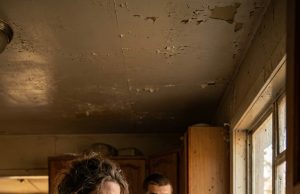
However, as the second week dragged on, the fire of my anger began to flicker and die, leaving behind a cold, cavernous loneliness. The house felt unnaturally large and devoid of life. I missed the sound of his laughter echoing off the kitchen tiles; I missed the way he would rest his hand on my stomach to feel the baby kick. But I was convinced that caving in would be an act of negligence toward our daughter. I truly believed I was the only one standing between our family and a catastrophe.
The Secret in the Oak Desk
By the fifteenth morning, I realized I could no longer exist in this toxic stalemate. I decided that if Elias wouldn’t act, I would. My plan was to call animal control while he was at his jobsite, arranging for them to remove the dog quietly. I knew he would despise me for it, perhaps for a long time, but I told myself he would eventually realize that the safety of our child was worth the fracture in our marriage.
To facilitate the surrender, I needed Silas’s medical history to prove his vaccinations were current. I walked into Elias’s small home office and began a systematic search of his desk drawers. I couldn’t find the manila folder anywhere. I checked the filing cabinet, the bookshelf, and finally reached for the bottom drawer of his heavy oak desk—a drawer that had always been kept locked. To my surprise, it wasn’t locked, but it was jammed tight. I had to brace my feet against the floor and pull with my entire body weight until it finally popped open with a violent lurch.
There were no veterinary records inside. Instead, resting at the bottom of the drawer was a small, hand-carved wooden keepsake box. My curiosity, fueled by weeks of desperation and a gnawing need for answers, overrode my sense of privacy. I lifted the lid.
Inside lay a weathered, leather dog collar, stained with dark, rusted patches that I realized with a jolt were blood. Beside it was a yellowed stack of newspaper clippings, and in the center sat a small, water-damaged notebook with a cracked spine. I picked it up with trembling fingers and opened the cover. Written in a fading, youthful blue ink was a single name: Maya.
My breath caught in my throat. Maya was Elias’s younger sister. Years ago, when we were first dating, Elias had told me that she had passed away after a long illness, a tragedy that had clearly left a permanent scar on his soul. He had asked me, with a quiet intensity, never to press him for details, and I had always respected that boundary.
I turned the page, and the reality I thought I lived in began to disintegrate. It wasn’t a notebook; it was a diary. Maya hadn’t died in a hospital bed surrounded by family. The messy, hurried scrawl revealed that when she was sixteen, she had fled their home to escape a toxic environment created by a stepfather while Elias was away at university, unaware of the escalating danger.
The Guardian of the Streets
For five grueling years, Maya had lived as a ghost on the streets of the city. She wrote of freezing nights under highway overpasses, of the constant, gnawing ache of starvation, and of the terrifying proximity of strangers who viewed her as prey. But halfway through the notebook, the tone shifted from one of pure survival to one of companionship.
She wrote about a rain-slicked Tuesday when she found a shivering, starving puppy behind a dumpster. She had shared her only piece of bread with him and named him Silas. From that entry onward, the dog became the protagonist of her life. Silas would curl around her feet at night, acting as a living radiator to ward off the frost; he became the only entity in the world she could trust.
Then I reached the entry that explained the scars. Maya had been cornered in a deserted subway station by a man with a knife. Silas, barely a year old at the time, had not hesitated. He had thrown his body between Maya and the blade, taking a brutal, sustained beating to protect her. He had lost half his ear and suffered deep lacerations to his head, but he had refused to move until the attacker finally fled into the night. Silas had saved her life at the cost of his own safety.
The ink on the final pages was blurred by my own tears as they fell onto the paper. Maya’s handwriting had become weak and erratic, detailing a rattling cough and a fever that made the world melt into hallucinations. She knew she was dying of pneumonia in the middle of a winter storm, and her final words were a plea to a brother she hadn’t seen in years.
“I am so cold, and I can’t catch my breath anymore. I’m sorry, Elias. I’m so sorry I didn’t call. If someone finds this, please find my brother. Tell him to take care of Silas. He looks like a monster, but he is just a frightened baby who hates the dark. Don’t let them put him in a cage. He was the only family I had out here.”
I dropped the notebook, my hands shaking so violently I couldn’t hold it. I reached for the newspaper clippings. The headline of the top article felt like a physical blow: “Loyal Canine Guards Deceased Owner Through Blizzard.” The report detailed how a scarred pit bull had stood over a young woman’s body for three days in sub-zero temperatures, refusing to eat or sleep, growling at any officer who tried to approach. He was protecting her even after she was gone.
Elias must have seen the news. He must have recognized her. He had gone to the city, identified his sister, and spent his life savings on a legal battle to pull that dog off death row just hours before the needle was due. He had brought Silas home not as a pet, but as the last living piece of the sister he had failed to protect.
The Breaking of the Storm
I sank to the floor of the office and sobbed until my lungs burned. Everything was clear now—the growling, the anxiety, the desperate need for proximity. Silas wasn’t aggressive; he was traumatized. He had knocked over the crib because the confined space of the nursery made him feel trapped, and he had bared his teeth at me because I had cornered him while screaming, triggering every defensive instinct he had forged on the streets.
And my husband. My poor, silent husband had been carrying the weight of his sister’s death and the burden of her final wish alone. How do you explain to your pregnant wife that the “monster” in the house is the only reason your sister didn’t die alone in the dirt? He couldn’t choose between my comfort and his sister’s legacy, so he had simply retreated into the garage to sleep on a cot so the dog wouldn’t have to face the dark.
I wiped my face with my sleeve, gathered the journal and the blood-stained collar, and walked downstairs. The winter air was biting as I crossed the yard toward the garage. I pushed the side door open quietly. The space was dim, illuminated only by the orange glow of the space heater. There was Elias, shivering on that pathetic cot, and curled in a massive, protective ball on top of his chest was Silas.
I didn’t say a word. I lowered myself onto the cold concrete floor beside them. Silas lifted his head, his torn ear twitching, his brown eyes alert and questioning. I offered the back of my hand to him, bracing for a growl that never came. Instead, Silas let out a soft, mournful whine. He slid off the cot and moved toward me, resting his heavy, scarred chin gently on my knee.
I wrapped my arms around his thick neck and buried my face in his fur, whispering apologies into his ears. Elias woke up then, his eyes widening in confusion as he saw his pregnant wife sitting on the garage floor, clutching the dog I had tried to exile. Then his gaze fell on the notebook in my lap.
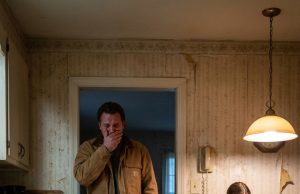
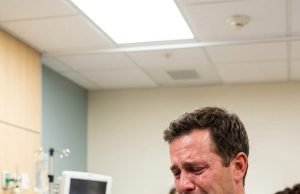
The stoic mask Elias had worn for two weeks shattered in an instant. A raw, agonizing sob tore out of him, and he slid off the cot to join me on the floor. The three of us sat there in the dim light of the garage, holding one another as years of unspoken grief and guilt finally found an outlet. I promised him then, through my own tears, that Silas would never have to sleep in the garage or the dark ever again.
The Watchman’s First Shift
Three months later, the house was filled with a different kind of silence—the soft, rhythmic breathing of a newborn. I brought our daughter, Grace, home on a Tuesday afternoon when the sun was high and the snow had finally begun to melt. I carried her upstairs to the nursery, where the crib had been repaired and returned to its place, and gently laid her down.
As I stepped back to adjust her blanket, I heard the familiar, heavy click of paws on the hardwood. Silas walked into the room with a slow, purposeful gait. He didn’t look nervous; he didn’t look like he wanted to pace. He walked directly to the side of the crib and lay down on the soft rug beneath it.
He rested his scarred chin on his paws and fixed his eyes on the nursery door, his ears pricked for the slightest sound. I realized then that he wasn’t just a dog we had rescued; he was a guardian who had been training for this role his entire life. He was no longer the broken animal from the streets; he was the watchman of our family, and for the first time in a year, Silas finally looked like he was home.