People hurried past a trembling young boy in the freezing cold, eyes averted and hearts closed.
Then a struggling girl finally stopped beside him and what happened next quietly warmed everyone who witnessed it, proving that compassion can still change lives in the most unexpected ways.
December in Seattle didn’t merely chill the air—it cut through skin and pavement like invisible blades, carrying the sharp smell of rain-soaked concrete and winter metal. The city rushed onward, indifferent to the season. Twelve-year-old Nora Lane, wearing scuffed red sneakers and a faded yellow backpack bought secondhand, walked briskly against the wind. In her hands, she carried a cardboard tray of homemade blueberry muffins, tied together with mismatched string. Every muffin she sold meant milk on the table, heat for their apartment, and one more month before eviction felt like a looming breath on their necks.
Her mother, Renee, worked nights cleaning office buildings while the city slept, coming home smelling of bleach and exhaustion. Still, every morning she kissed Nora’s forehead and reminded her that kindness was the one kind of wealth no one could ever steal.
Nora didn’t grow up worrying about Wi-Fi speeds or cracked phone screens. Her awareness was sharper, shaped by survival rather than comfort. Life had taught her that suffering doesn’t always cry out—sometimes it curls quietly on a cold sidewalk, waiting for someone to notice.
That’s when she saw him.
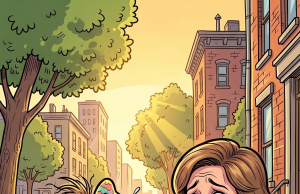
The boy sat near the entrance of a busy shopping area, knees pulled tightly to his chest, shoulders shaking uncontrollably. Frost melted into his dark hair, plastering it to his forehead. His coat had once been expensive, but now it hung loosely, as though the warmth it promised had long disappeared. People streamed past him—some glanced briefly, others frowned in annoyance, many pretended their headphones made them unaware. A few children pointed before being tugged away by impatient adults. Humanity filled the street, yet compassion felt absent.
But Nora stopped.
She leaned her bike against a railing and approached him cautiously, the kind of gentle courage only children who have suffered yet still believe in goodness possess. Kneeling so she wouldn’t loom over him, she whispered, “Hey… are you okay?”
For a moment, he stayed silent, as if his words were frozen somewhere inside him. Then his voice broke free in uneven fragments.
“I ran away… my uncle yelled… my dad didn’t listen… nobody ever listens. They just tell me to be strong.”
The way he said strong sounded too heavy for someone so small.
Nora swallowed hard. She didn’t know his full story. She had no money, no power, no stable future to offer. But she understood loneliness. She knew what it felt like to be unseen. So she did the only thing her heart told her to do—she slipped off her worn hoodie despite the cold biting instantly into her arms, wrapped it gently around his shaking shoulders, and smiled as warmly as she could.
“It’s not much,” she said softly, “but it’s warm. And I think that’s what we both need right now.”
The boy stared at her, stunned, as if kindness itself were something unreal. “Why are you helping me?” he asked.
“Because ignoring you hurts more than the cold,” Nora replied.
She helped him to his feet and guided him toward a nearby shelter she knew well—not because she volunteered there, but because she and her mother had once waited outside it on nights when poverty felt too loud to escape. The shelter staff gave him a blanket. Nora gave him a muffin. He ate slowly, as if each bite mattered.
Across the city, panic was unraveling a very different world.
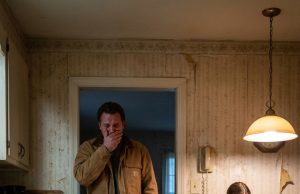
Alexander Reed, a billionaire tech executive known for his icy interviews and emotionless presence, was spiraling. His only son, Leo Reed, had disappeared after an argument with Alexander’s sister, Monica, who believed discipline was the same as love. Since the accident that took Leo’s mother, Alexander had buried himself in meetings and strategies, replacing emotion with control. Now none of it mattered.
When a volunteer called to say Leo had been brought to a shelter by a young girl who refused to leave until he warmed up, Alexander drove faster than he ever had in his life.
What he saw inside shattered him.
Leo sat wrapped in an oversized, faded hoodie beside a girl wearing shoes with worn-out soles. She gently placed crumbs of a blueberry muffin into his hand as though they were precious gifts. Alexander dropped to his knees, his voice breaking for the first time in years.
“Leo… I’m so sorry.”
Leo hesitated before hugging him, and that hesitation hurt more than anything else ever had.
Alexander turned to Nora, seeing in her eyes something purer than all the charity events he had ever hosted.
“You saved my son,” he whispered, pressing money into her hand.
But that wasn’t the moment everything changed.
The real change came later.
Two days afterward, a black luxury car stopped outside Nora’s rundown apartment. Leo waved excitedly from the window. “Dad says we can visit! Please come!”
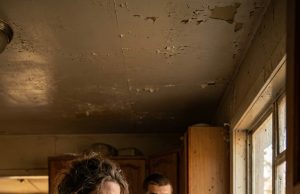
Renee hesitated. “We don’t belong in places like that,” she murmured.
But kindness had already woven a bond between the children that money couldn’t buy. So they went.
The Reed estate was breathtaking—glass halls, marble floors, towering walls—but beneath the luxury lived an echoing loneliness. The silence felt heavier than poverty ever had.
Nora’s presence changed everything. Leo laughed again. The house felt alive.
Alexander offered help—not charity, but gratitude. Housing. Education. Stability.
Life softened… until jealousy and secrets resurfaced.
When Renee later passed away from heart complications, grief returned—but this time, Nora wasn’t alone.
Alexander adopted her.
Not because blood demanded it—but because love chose it.
Years later, Nora stood on stage at a foundation gala she had founded to help children facing grief and poverty. She spoke into the microphone, her voice steady but emotional.
“I once gave my only warmth to a boy in the cold. I thought I was saving him. I didn’t know he was saving me too.”
The applause was real. Earned.
Later that night, she noticed another child struggling on the street.
She knelt, smiled, and placed her coat around his shoulders.
“We see you,” she whispered.
Because sometimes, love doesn’t repeat pain.
It repeats kindness.
Life Lesson:
True compassion begins when you stop while the world keeps walking. One small act of kindness may not change everything at once—but it can rewrite destinies, heal wounds money can’t touch, and build families defined not by blood, but by love.