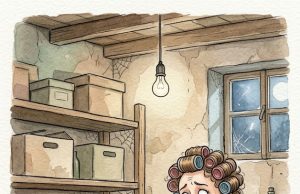
At just eighteen years old, she was given in marriage to a widower with three children.
Everyone thought that was the end of her youth… and her dreams too.
But time proved that it wasn’t the end… but the beginning of a miracle.
At eighteen, in the winter of 1878, Luz Robles was given in marriage to a widower with three children in the mountains of Durango.
In those times, on the remote ranches of the Sierra Madre Occidental, decisions were not always guided by a woman’s heart…
but by necessity.
The wind drifted down through the pines like an ancient lament.
The snow covered the dirt roads, erasing footprints…
as if it wanted to erase destinies as well.
Luz stood on the porch of her uncle Prudencio’s house, her mother’s gray shawl pressed tightly against her chest.
She wasn’t crying.
Since her mother died six years ago, she had learned that tears don’t change the course of a cart.
Inside, in front of the stove, the deal was sealed.
“It’s intact,” the uncle said, without shame. ”
Strong. She knows how to work. She’s not fragile.”
The man listening was tall, with broad shoulders, holding his hat in his hand.
Cayetano Guerra, a thirty-six-year-old rancher, widowed for three years.
His gray gaze wasn’t cruel…
it was tired.
A bag containing silver coins and a document for a good-blooded steer fell onto the table.
—We’re even.
Luz didn’t protest.
In those days, women weren’t asked questions…
they were taken away.
He climbed into the wagon without looking back.
The snow began to cover his footsteps even before the horse started moving, as if the world were quickly accepting that he no longer belonged there.
The El Encino ranch, on the outskirts of Nombre de Dios, seemed suspended in the endless white.
The house withstood the wind with a weathered dignity.
Tools that Clara, the deceased wife, used to meticulously organize still hung in the barn.
The children watched her from the hallway.
Rosita, three years old, hidden behind her brother Elias.
Matias, the eldest, eight years old, with his arms crossed and his gaze hardened by a loss too great for his age.
“Good afternoon,” Luz whispered.
Matías turned around.
Thus began his new life.
The first few days were a series of mishaps.
The stove wouldn’t work. The griddle kept burning. The well water cut her skin.
She didn’t know how to braid Rosita’s hair or soothe Elias’s nighttime crying.
But he did not give up.
And Cayetano… watched.
He didn’t raise his voice. He didn’t give praise.
Yet every morning a note appeared by the stove:
“Use oak firewood. It lasts longer.”
“Elias prefers beans with epazote.”
And once, under a chipped plate:
“You don’t have to do it perfectly. Just don’t give up.”
Those words gave him more warmth than fire.
At night, if she left the dishes unwashed, they would be clean by dawn.
If she forgot the firewood, it would appear piled up.
No one spoke of these gestures.
The ice began to crack silently.
The disease arrived as misfortunes do in the countryside: unannounced.
Rosita stopped eating. She was burning with fever. In her sleep she called for her mother.
Luz didn’t hesitate. She prepared mint infusions. She changed cloths. She got into bed with the girl to give her human warmth. Three sleepless nights. Three nights inventing prayers that no one had taught her.
On the third night, Cayetano remained outside the room that had once belonged to Clara.
He didn’t knock.
He only looked through the fogged window.
She saw Luz singing softly, holding her daughter as if she had given birth to her.
She lowered her gaze.
She did not correct her daughter when, at dawn, Rosita murmured:
—Thank you… Mom Luz.
That word wasn’t small.
It was a silent earthquake.
Days later, Luz discovered Clara’s simple grave behind the house.
It didn’t compete with the memory. It cherished it.
She placed wildflowers and whispered:
—I’m not here to take your place. I just want to make sure your children are never alone again.
That night, Matías asked in a low voice:
—Did you spell her name right?
-Yeah.
The boy nodded.
It wasn’t affection yet.
But it wasn’t rejection anymore.
But the pain doesn’t disappear without leaving scars.
One night, Luz heard voices in the barn.
—I took her for convenience— Cayetano said.
—I needed someone to look after the house.
“That’s all.”
It didn’t hurt like an insult.
It hurt like the truth.
She felt she was not a woman…
but a tool.
If it was just about convenience, then it didn’t matter.
And all she had silently asked for was that: to matter.
That morning he left a letter on the table:
“If I am a shadow, let me go before spring arrives.”
She wrapped herself in her coat and went outside.
The cold bit at her ankles.
The snow crunched under her feet.
She didn’t look back.
When Cayetano found the letter, something broke inside him.
He mounted his horse without a second thought.
He followed the tracks, almost erased by the wind.
He found her by the frozen stream, small and shivering, as if the world were too big for her.
He knelt down.
“I don’t know how to love well,” he confessed. ”
When Clara died, I closed my heart. I thought silence was safer.
But with you, I learned that silence hurts too.”
Luz looked at him with wounded dignity.
—I didn’t want you to love me. I just wanted to matter.
Cayetano let a tear fall onto the snow.
—You matter more than you imagine.
It wasn’t a perfect speech.
It was awkward.
It was human.
It was true.
They returned together.
But sometimes forgiveness is not the end of the story…
but the beginning of the most difficult test.
What the snow couldn’t break…
life would try to do.
And when spring arrived in El Encino, nobody was prepared for what was to come.
Spring changed the landscape.
Green shoots broke through the earth where months before there had only been white and silence.
But not all life begins without pain.
Cayetano led Luz to the clearing where Clara’s ashes rested. The air smelled of damp earth and pine resin. There was no recrimination there. Only memory.
He took an antique pearl necklace from his pocket. They didn’t shine with luxury, but with history.
“It belonged to my mother,” she said, in the most vulnerable voice she had ever heard from her. “Clara kept saying it should stay in the family… for the woman who would raise our children.”
The world seemed to hold its breath.
When he placed it on her neck, her hands trembled. It wasn’t a romantic gesture. It was a surrender.
—Now I see you.
Not as a shadow.
Not as a replacement.
Not as a debt.
I saw her.
And at that moment, something inside Luz stopped asking for permission to exist.
The blow came without warning.
An April storm raged down on El Encino. The wind rattled the windows as if it wanted to tear apart what little remained standing.
Matías ran towards the corral before anyone could stop him.
A slip.
A scream.
A small body falling against the wood.
Then, blood.
Silence.
That silence that is not the absence of noise… but the absence of breath.
Luz felt her heart break in two when she saw the child’s temple stained red.
“Matías!” Her voice was no longer firm. It was naked fear.
They rushed him to the small clinic in Nombre de Dios. The doctor spoke in a low voice, as if volume could alter fate.
—We have to wait.
Wait.
The cruelest word in the language.
That night, Luz didn’t move from the side of the bed. She didn’t eat. She didn’t sleep. She didn’t pray with pretty words. She prayed with desperation.
He whispered in her ear.
He told her made-up stories.
He promised her mornings with horses, hot bread, and laughter.
“You can’t give up now,” she whispered, her forehead resting on her cold hand. “We’re just learning how to be a family… don’t leave me alone in this.”
Cayetano watched from the doorway. A big man shrunk to the size of his fear. He didn’t know how to save his son. And for the first time, he understood that he couldn’t save himself either.
So…
A movement.
A finger.
A slow blink.
Matías’s eyes opened with difficulty.
And in a small, broken voice, she asked:
—Did you cry for me… Mom?
The word hit like lightning.
Mother.
No “Light”.
No, “ma’am”.
Mother.
Something broke.
But it wasn’t the heart.
It was the last wall.
Luz cried without dignity, without restraint, without a mask.
From the doorway, Cayetano also cried. And he didn’t hide.
Because at that moment she understood that love had not come to her house as a substitute.
He had arrived as salvation.
They got married weeks later.
There were no imported dresses or city music.
There was a simple mass, under a twisted oak tree that had withstood more winters than anyone could count.
The village priest spoke of second chances.
Rosita brought flowers she had picked herself from the garden.
Elias almost dropped the rings, red with nerves.
Matias held Luz’s hand with newfound strength, like someone who didn’t want to lose what he already recognized as his own.
—You look pretty, Mom.
And this time no one doubted that word.
The wind that had lashed that house so many nights blew gently that day. As if even the sky had decided to rest.
But the story had not yet come full circle.
Weeks later, Uncle Prudencio appeared on the dusty road. More hunched over. Older. Smaller than Luz remembered.
Guilt ages faster than years.
“I sold you like cattle,” he admitted bluntly. “I thought it was for the best. I thought you had no future.”
She looked at him for a long time.
There was no hatred.
There was memory.
“You took away my choice,” she replied calmly and firmly. “But I chose what to do with what I had to live through.”
He did not absolve him of what he did.
But he decided not to carry it anymore.
Because forgiving isn’t erasing.
It’s ceasing to bleed from the same wound.
Prudencio wept. And he left lighter than when he arrived.
May brought warm rain.
No storm.
No destruction.
Rain that nourishes.
That afternoon, as the countryside breathed green, Luz took Cayetano’s hand and placed it on her barely rounded belly.
He said nothing.
It wasn’t necessary.
He understood.
Her eyes filled with something greater than joy. It was trembling gratitude.
“I lost a good woman,” he murmured. “And God gave me another… not to replace her, but to save what’s left.”
He hugged her like someone holding something sacred and fragile at the same time.
And in that corner of Durango where a young woman was handed over as a bargain… where she arrived believing herself to be a shadow…
Winter did not have the last word.
Because sometimes what surprises the world is not that two people meet.
It’s that, after the betrayal, the fear, and the loss…
Decide to stay.
And build.
Together.