My name is Elena Hart, and when my divorce was finalized, it felt less like closure and more like escaping a blaze. I left the United States with only two suitcases and a one-way ticket to Lisbon, intent on building a life no longer centered on Mark—the man who spent years persuading me that my ambitions were negotiable while his were non-negotiable.
Two months after I moved overseas, Mark married Sabrina, the woman he’d been seeing quietly long before our marriage fell apart. Their wedding took place mere weeks after the divorce was official—a timeline so neatly compressed it hardly required explanation.
I told myself I was indifferent. I wanted to believe that.
I settled into a small apartment overlooking the rooftops of Alfama, returned to remote work as a design consultant, and began piecing together a version of myself that had been absent for years. Life finally grew calm in a way that felt healing… until the day of Mark’s wedding arrived.
Naturally, I wasn’t invited. I didn’t expect to hear a word about it. But that evening, as I sat on my balcony sipping vinho verde, my phone buzzed with a message from an old friend still living back home.
“You won’t believe what just happened at the wedding.”
That was how I found out what had unfolded.
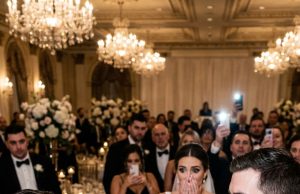
According to my friend, the ceremony and reception were held at a luxury vineyard—exactly the kind of dramatic setting Mark loved to showcase. Everything went according to plan until a guest named Harold struck up casual conversation at the dinner table. He was a distant connection of Mark’s family and, apparently, had stayed in touch with my aunt.
Harold never intended to stir up drama. He casually mentioned that he’d recently spoken with my aunt, who told him I’d “moved to Europe and was thriving,” adding that I’d landed a major international contract and was “doing far better financially than before.”
He thought it was harmless small talk.
Instead, it set everything off.
According to witnesses, Mark went rigid, his jaw clenching as he pressed for more information. When Harold shared the rumored value of the contract—figures Mark never believed I could achieve on my own—Mark’s face went pale. Sabrina, standing beside him, murmured something to soothe him, but it only escalated things. Mark snapped at her, saying she “had no idea what she was talking about,” then turned back to Harold and bombarded him with questions.
The music cut out. Conversations died. All eyes turned toward them.
Sabrina tried to guide her new husband away, but Mark brushed her off, shouting that I had “no right” to be more successful than he was.
The scene unraveled quickly. A glass shattered. A table rattled. The bride’s flawless smile crumbled into public humiliation.
While chaos exploded in that vineyard ballroom, I was thousands of miles away, completely unaware of the reaction my name had sparked.
Then my phone rang.
It was Mark.
That was when everything truly began.
When his name lit up my screen, I stared at it for nearly ten seconds—long enough for the call to end. He didn’t leave a voicemail. I assumed that was the end of it, just an impulsive moment driven by wounded pride and embarrassment.
I misjudged him.
Five minutes later, my phone rang again.
This time, curiosity won out, and I answered.
The line was filled with raised voices and the clatter of dishes. He wasn’t alone. His breathing was quick and uneven, like someone struggling to regain control after everything familiar had slipped through his fingers.
“Elena,” he said. Hearing my name in his voice felt strange, almost unfamiliar. “We need to talk.”
“No,” I replied evenly. “You need to calm down.”
He ignored me. “Why didn’t you tell me you were working with international clients? Why didn’t you say anything about moving into… whatever kind of life you suddenly have?”
I took a slow breath. “Why would I?”
The silence that followed was sharp and broken. For years, Mark had treated my goals like side projects—useful only if they supported his success. It had never crossed his mind that I might surpass him.
“You could’ve told me,” he said again, his voice cracking in a way that almost sounded exposed. “You made me look like an idiot in front of everyone.”
“I didn’t do anything,” I said calmly. “You chose how you reacted.”
He let out a harsh breath. For a moment, all I could hear was chaos in the background—someone calling Sabrina’s name, someone else asking whether the next toast should be canceled. He muttered something away from the phone, then came back sounding unsteady.
“You caught me off guard.”
I nearly laughed. “Mark, you caught yourself off guard.”
He wasn’t used to that—to hearing the truth without it being softened. He’d always been the confident one, the dominant voice, the final authority. But this wasn’t revenge. What happened at that wedding was simply the inevitable collapse of a man who built his life on ego instead of honesty.
“Elena… are you happy?” he asked.
The question was quiet, unsure, almost afraid.
“Yes,” I said. And for the first time in years, I meant it.
He didn’t know how to respond. I could feel it in the long pause stretching between us, across continents. In his mind, I had always existed as a supporting role in his story. It had never occurred to him that I might be living my own.
“I think we made a mistake,” he finally said. “I made a mistake.”
I leaned back, listening to the distant sounds of a wedding unraveling behind him.
“You made more than one,” I replied. “But they’re yours to deal with. Not mine.”
He didn’t argue. He didn’t explode. He just breathed—slowly, heavily, like someone finally giving in.
When the call ended, I stayed on my balcony, looking out over the city lights. In the silence, I felt something unexpected.
Not victory.
Not resentment.
Just closure.
Pure, uncomplicated closure.
The days that followed were unusually calm. Lisbon felt warmer, steadier, as if everything had finally fallen into place. I returned to my projects, met friends for coffee, wandered neighborhoods I hadn’t explored yet. Life moved softly, and for once, I didn’t resist it.
Still, the aftermath of Mark’s breakdown traveled farther than I anticipated.
Two weeks later, a former colleague from the States emailed me. She apologized for the gossip but said people were talking about the wedding disaster. Word spread quickly in the circles Mark once controlled. Clients pulled away. Business partners questioned his reliability. Sabrina stopped posting her picture-perfect narrative, confirming rumors that she’d moved out—at least temporarily.
I didn’t reply. None of it concerned me anymore.
What mattered was the distance—both emotional and physical—between me and that old life.
My career took off. The international contract Harold mentioned was just the beginning. A boutique hotel in Spain reached out, followed by a gallery owner in Porto. I traveled for meetings, absorbed new cities, and built something Mark never believed I was capable of creating.
A life defined on my own terms.
One afternoon, sketching layout ideas at a café overlooking the Tagus River, I received another message from Mark. This time, there was no panic or accusation. Just a short note:
“I hope you’re doing well. I’m sorry for everything. I finally see how wrong I was. I’m working on fixing things. I won’t contact you again.”
I read it, then closed the message. I didn’t feel the need to respond.
Healing doesn’t always look like forgiveness. Sometimes it simply looks like moving on without turning back.
Weeks passed. Then months. I built friendships, settled into routines, learned Portuguese slowly and imperfectly. I filled my apartment with things that felt like me—plants, handmade mugs, vintage prints from street stalls. The space mirrored the woman I was becoming: steady, self-reliant, unhurried.
One evening, standing on my balcony as the city turned gold at sunset, I realized how far I’d come from the woman who once walked on eggshells, waited for approval, and shrank herself to keep the peace.
The truth was simple:
I didn’t escape Mark.
I outgrew him.
And nothing about his wedding—the chaos, the humiliation, the fallout—changed the reality that my life was finally expanding in ways it never could when I lived in his shadow.
My story didn’t need a villain.
It just needed a beginning.
And Lisbon gave me exactly that.