The Keepers of Silence
For twelve long years, Noah Rowe existed in absolute visual isolation.
It wasn’t a world of soft shadows or blurred, indistinct silhouettes. It was a dense, impenetrable, and unchanging void. Medical professionals categorized it as idiopathic blindness. Others threw around technical phrasing, calling it a rare neurological anomaly or a profound psychosomatic response.
Yet, despite their clinical vocabulary, no expert could provide his father with a definitive explanation for why the light had vanished—or how to coax it back.
And so, the dark remained.
The Architect of Fixes
Alexander Rowe wasn’t a household billionaire dominating Wall Street. He didn’t possess a collection of private hangars or a high-profile legacy. But he was a self-made man of considerable resources, having built a highly profitable mid-sized tech enterprise developing encrypted cybersecurity frameworks for municipal infrastructure across the West Coast.
His success was more than enough to guarantee an incredibly comfortable existence. It allowed him to secure elite international consultations, enroll in avant-garde medical trials, and finance any therapeutic regime money could command.
In the beginning, that financial leverage made him believe he could dismantle any obstacle.
When Noah’s vision evaporated overnight at the age of seven, Alexander instantly channeled his panic into relentless logistics. He coordinated private flights to specialized clinics in Switzerland, retained the minds of world-renowned neuroscientists, and personally funded cutting-edge cellular therapies that conventional insurance policies refused to touch.
But at the conclusion of every high-priced consultation, the diagnostic verdict remained identical:
The physiological structure of the eyes is flawless. The optic pathways are entirely intact. There is absolutely no biological impediment to his vision.
Initially, Alexander aggressively hunted for a clinical cure. Later, as the years bled together, his quest mutated into a desperate search for accountability.
Because Noah hadn’t been born into the dark.
The Fracture
The blindness had materialized in direct synchronization with the day his mother departed this world.
Twelve years prior, Evelyn Rowe had perished in a devastating, single-vehicle collision on a slick, rain-swept highway outside Monterey. The highway patrol had filed it as an unfortunate loss of traction. A tragic, instantaneous accident.
Alexander had accepted the official police report.
Noah, however, never uttered a single syllable regarding the events of that evening. He ceased asking questions about his mother. He abandoned his sketching pads. He refused to look at the landscape around him.
And one ordinary morning, he simply woke up unable to perceive the light.
Eventually, Alexander was forced to accept that certain structural fractures could never be repaired by a checkbook. He shifted his focus to the variables he could manipulate, retrofitting their estate for total accessibility, retaining elite private tutors, and mastering the art of absolute stillness whenever his son required isolation.
Yet, during the quiet midnight hours, Alexander consistently wondered what vital piece of humanity his child had surrendered on that asphalt besides his sight.
The Uninvited Guest
Late one afternoon, Noah sat alone in the stone courtyard behind the main residence, his fingers tracing the ivory keys of the antique upright piano his mother had cherished. Music functioned as the solitary sanctuary where the lack of light didn’t register as a threat.
That was the precise moment an intruder breached the perimeter, slipping silently through the unlatched iron side gate.
The security logs later revealed a slender young girl, entirely barefoot, clad in an oversized, faded hooded sweatshirt and denim trousers that stopped inches above her ankles. She navigated the brick path with a cautious, fluid hyper-awareness—the unmistakable movement of someone accustomed to being aggressively chased away from property.
Her identity was Mara Bell.
The local shopkeepers recognized her as the quiet, watchful teenager who frequented the edges of the public pier. She never engaged in aggressive panhandling; she simply observed the passersby with an intensity that felt entirely uncharacteristic for someone her age.
The uniform patrol guard instantly boomed across the garden. “Hey! Step away from the resident! You’re trespassing!”
Noah raised an open hand, freezing the guard in his tracks. “Please,” he directed calmly, his head tilting toward the sound of her footsteps. “Allow her to remain.”
Mara came to a halt mere inches from the piano bench. She didn’t offer a rehearsed apology, nor did she solicit spare change. Instead, she delivered a statement with absolute conviction:
“Your biology isn’t broken.”
Alexander stepped out onto the veranda, an immediate spike of protective anger tightening his jaw. “That’s quite enough,” he barked, stepping between them. “You need to vacate the premises immediately.”
But Noah deliberately shifted his posture toward the frequency of her voice. “What do you mean by that?” he inquired softly.
Mara took a step closer, ignoring the father’s imposing silhouette. “There is a physical presence inside your mind that is actively forbidding you from witnessing reality.”
The diagnosis hit Alexander like an absolute insult. He had spent over a decade navigating the upper echelons of global medicine, burning millions of dollars on elite opinions, and now a homeless vagrant from the pier was claiming superior insight?
“Noah,” Alexander intervened, his voice tight with warning. “Do not engage with this nonsense.”
But Noah extended his arm, his fingers finding Mara’s wrist before gently guiding her palm directly against his jawline. “Vindicate your theory,” he murmured.
The Extraction
Mara’s fingertips were icy cold and trembling slightly as they traced the contour of his cheekbone. Then, executing a maneuver of terrifying, micro-surgical precision, she slipped the edge of a fingernail beneath the membrane of his lower eyelid.
“Step back from my son!” Alexander roared, lunging forward.
He was a fraction of a second too late.
A small, physical anomaly slid free from the tear duct, settling directly into the center of her open palm.
It wasn’t a biological crystallization or a particle of debris. It was a miniature, obsidian-hued, segmented entity.
Alexander felt his stomach violently churn.
The bizarre creature twitched in the light, emitting a low, mineral scraping sound—resembling two shards of glass being ground together under immense pressure.
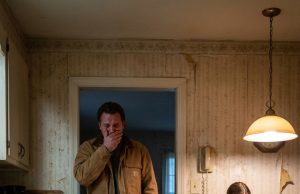
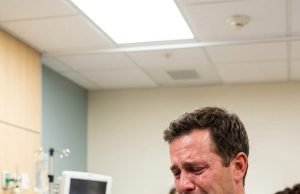
Noah let out a sharp, ragged gasp—not a reaction to physical trauma, but a sudden, overwhelming sensation of structural release. A profound weight he had balanced inside his cranium since the age of seven dissolved into nothingness.
“Get away from him!” Alexander screamed, horrified.
Mara instantly flipped her palm over. The anomalous entity plummeted onto the flagstones, scurrying with a mechanical speed beneath the shadow of the piano base.
“Do not attempt to crush it,” she warned without raising her volume. “If you exert pressure, its core simply divides.”
An eerie, absolute silence blanketed the courtyard.
Noah swallowed with immense difficulty, his hands trembling against the piano keys. “There is a second presence,” he whispered into the quiet. “My left eye is burning.”
The Archive of Lies
Alexander’s pulse hammered violently against his ribs. If one of these monstrous anomalies existed… the biological logic demanded a counterweight.
Instead of approaching the boy again, Mara dropped to her knees beside the masonry wall anchoring the piano, tracing her fingertips along a microscopic fissure running parallel to the wooden baseboard.
“The extraction isn’t finished,” she murmured, her ear pressed against the drywall. “They have established a colony inside the structural framework. They are nesting.”
From the interior cavity of the partition came a muffled, damp friction—the sound of dozens of miniature, segmented bodies shifting against one another in the dark.
Alexander immediately radioed his estate manager, commanding the immediate destruction of the drywall panel.
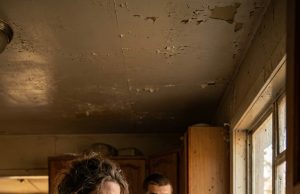
When the plasterboard was systematically extracted, it revealed a hollow structural void packed with a cluster of the dark entities. They weren’t feeding on the timber or the insulation; they were sustaining their lifecycle on something entirely abstract.
Darkness. Hidden traumas. Subrupted memories.
Cradled in the dead center of the parasitic cluster sat a small, tarnished silver music box.
Alexander identified the heirloom instantaneously. It was an antique piece that had belonged exclusively to Evelyn.
Prying the latch open, he discovered a single, water-damaged photograph of Noah and his mother sharing a candid laugh beneath a brilliant sun. Flip over the card stock, a frantic, jagged script stared back at him in her handwriting:
I can no longer obscure the reality. He witnessed the entire sequence. Alexander must remain entirely oblivious to the threat.
Noah’s entire posture locked up, his muscles turning to stone.
And then, the dam broke, and his voice dropped to a gravelly, ancient whisper:
“The collision… it was never a mechanical failure.”
The suppressed psychological files flooded his consciousness with the force of a tidal wave. The escalating argument before departure. The headlights of the black sedan tracking their movements through the fog. The sudden, intentional pit-maneuver on the highway. The absolute terror of the impact.
Suddenly, a mechanical click echoed from the deep recess of the hollow wall. A hidden utility door, long forgotten in the architectural blueprints of the estate, slid open.
A figure stepped out from the shadows into the light—Daniel Price, a disgruntled former executive assistant whom Alexander had aggressively terminated and blacklisted from the tech industry over a decade ago. He had been living like a phantom within the structural blind spots of the house.
The police arrived within ten minutes, securing the perimeter and placing him under arrest. The man fractured under interrogation, offering a comprehensive confession to the systemic campaign of stalking, the execution of the highway collision, and the permanent containment of the truth.
Noah had taken in every single detail from the passenger seat. And his young psyche had opted for absolute blindness as the ultimate mechanism of survival.
The Return of the Light
The entities weren’t a parasite or a biological infection.
They were an evolutionary defense system—sentinels manifested by the subconscious to insulate the human mind whenever the unvarnished truth was too monstrous to endure.
As the pristine morning sun cleared the horizon, bathing the courtyard in amber, Noah blinked rapidly, his pupils dilating.
The color palette of the world rushed back into his mind, followed by hard geometric lines and depth perception. The very first face his newly restored vision truly registered was the weathered countenance of the girl from the pier.
“Why did you choose to unearth this for me?” he asked, his voice thick with emotion.
She offered a subtle, detached shrug of her shoulders, turning back toward the iron gates.
“I harbored one inside my own mind for a season,” she shared quietly, her eyes clear. “Mine didn’t compromise my vision. It simply equipped me with the capacity to identify the darkness hidden inside everyone else.”
She exited the property without looking for a financial reward or a handout. She turned back one final time to deliver a solitary mandate:
“Ensure he never again averts his gaze from what is true.”
Because the most destructive brand of blindness will never be a physiological failure of the tissue.
It is the dark reality we willingly choose to inhabit.